While researching in Ohio newspapers, Dr. Margaret Sumner, associate history professor at The Ohio State University in Marion, was struck by the many stories she found about Marion’s Black community after the Civil War. While many residents know the story about Black and white activists helping Bill Anderson escape slavecatchers and flee to Canada along the Underground Railroad in 1839, the activities of Black citizens after the Civil War are not as well known.
“There’s a long legacy of Black organizing and leadership in Marion, political, economic, and social, that continues to this day,” Dr. Sumner said.
In Marion after the Civil War, Black men regularly voted and became politically active, traditionally favoring Lincoln’s Republican party in the early years. Many Civil War veterans became community leaders. Black-led churches like the African Methodist Episcopal Church and Mt. Zion Baptist Church became important centers of activism. Black families became some of Marion’s earliest business owners.
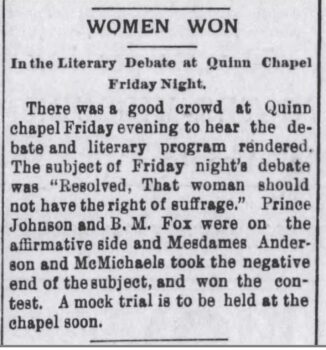
“From the 1870s onwards, they were organizing to improve Marion and the nation. Black women were demanding the vote by 1897 – much earlier than Marion’s white women leaders who got active in the 1910s. The community founded many social and political clubs from which they publicly protested racial prejudice, urged politicians to protect Black civil rights, and denounced lynching,” Dr. Sumner said.
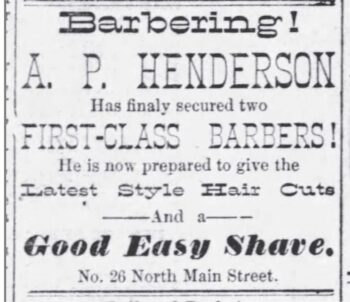
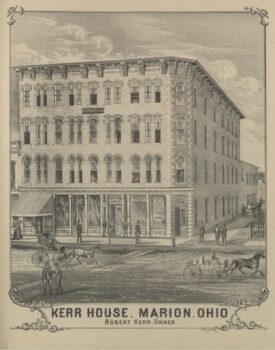
From the 1860s to the 1890s, Adam P. Henderson was one of these local leaders, running a popular barbershop in downtown Marion. He and his wife, Henrietta, helped found the African Methodist Episcopal Church on Park Street
“They modeled early examples of vibrant Black leadership,” Dr. Sumner said. “Henderson mentored dozens of young Black men in his shop, training them as barbers, tutoring them as businessmen, leading them in political activism and the fight against racial prejudice.”
Henrietta Henderson founded one of the first Black women’s organizations in Marion. Her “Willing Workers” group mentored young women, fundraised for charity, and worked for temperance and women’s suffrage, Dr. Sumner found.
“By 1900, thanks to the work of Black leaders like the Hendersons, there was a well-organized network of younger activists in Marion who were ready to confront persisting racial prejudice and continue the call for economic, political and social equality for all,” Dr. Sumner said.
World War I – Patriotism
While never hesitant to protest the problems in the nation, Marion’s Black community always answered the call to protect it. When twenty-three local Black men were drafted to fight in World War I, Black leaders organized a farewell reception to see them off, and organized a parade in which Marion’s mayor and many Black and white citizens took part. Four Black Civil War veterans attended to support these young men.
At the parade, Black women collected donations in a large American flag. They raised over $1,000 to the Red Cross. This was a significant sum, as that was more than most people made in an entire year of work, according to the U.S Bureau of Labor Statistics.
“There’s a strong sense of patriotism in support of not only Marion but the community and the country,” Dr. Sumner said.
After the first World War, two veterans, Milton Lashley and Pinckney Nichols, organized and led Marion’s first Black Boy Scout Troop. The community, as always, focused on the future.
Free Lecture Series
The public is invited to attend Dr. Sumner’s next presentation on Monday, Aug. 7 from 6 p.m. to 8 p.m. in the Harding Centre Ballroom. The title of her talk is, “Organized against Racism, Open to Innovation: New Black Networks Moving Marion Forward, 1940 to the present.”
This is the last in a free lecture series sponsored by Ohio State Marion, the Interdenominational Ministerial Alliance, the Peace and Freedom Committee, the Black Heritage Council, the Shepherd’s Fellowship, Lois J. Fisher and Associates and the Marion Area Chamber of Commerce.
Black History Display at the Marion Historical Society
Residents are also invited to see the ongoing Black History exhibit at the Marion County Historical Society at 169 E. Church Street. It is open Wednesday through Sunday from 1 p.m. to 4 p.m.