Young attorney Ozias Bowen came to Marion in 1828 and started his law office. Five years later, he married Lydia Baker, daughter of town founder Eber Baker. Their house at 270 East Center Street was the first brick house in the village of Marion (now occupied by Laipply’s Printing & Marketing Services.) Bowen admired the ancient Greek and Roman republics. He built his house with the end gable facing the street, making his house resemble the silhouette of a Greek temple with its strong triangular pediment framed in heavy molding.
As a judge, Bowen presided over the famous Slave Trial of 1839 in Marion, two decades before the official beginnings of the Civil War.
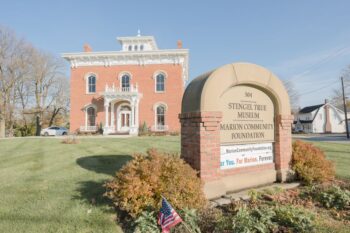
In 1862, Judge Ozias Bowen decided to move from his house on East Center Street to Berry’s Hill, also known as Gospel Hill, the highest point in Marion County. Judge Bowen was one of the early settlers of Marion and later became an Ohio Supreme Court Justice. The brick mansion was completed in 1864 at a cost of $20,000 and is a beautiful example of Italianate architecture with a cupola, elaborate plaster moldings and carvings, ornate woodwork, and stunning marble fireplaces throughout the home. It is situated at the five-points intersection of Washington Street, Delaware Avenue, and State Street.
The Bowen home eventually fell out of family ownership and into disrepair. Judge Bowen’s grandson, a local banker, and philanthropist Henry True purchased the mansion in 1918. True was Valedictorian of Princeton University, a voracious reader and preservationist of Marion’s history. He spent the next few decades restoring the mansion. Durin
g the early to mid-20th century, the mansion served as an upscale rooming house. It was later a local architect’s office.
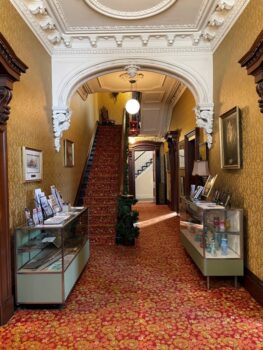
By the 1960s, the house was restored to its original grandeur and became a repository for the vast collection of optometrist, jeweler, and hobbyist, Dr. Frederick Stengel, a close friend of Henry True. Dr. Stengel was an outgoing person who enjoyed sharing his various collections with the public. Stengel’s collections record the early life of Marion, as well as elsewhere, and includes an impressive and eclectic assortment of antique clocks, Civil War objects, early American furniture and antiques, Native American and prehistoric artifacts, ceramics and glassware, some Warren G. Harding memorabilia and numerous other items.
The home includes the impressive entrance foyer, four rooms on each floor, an upper hall, and third-floor hall leading to the cupola and a fine view of the city. The rear of the mansion contains the two-story servants’ quarters and a garage.
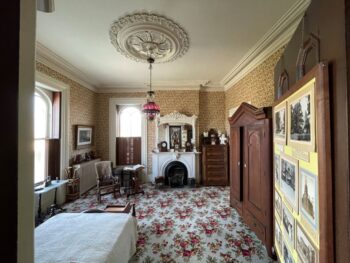
Unable to be self-sustaining as a house museum, the Bowen-Stengel-True mansion became home to Marion Community Foundation in 2004. The foundation has a staff of six and manages 400 endowment funds totaling nearly $65 million and awards over $2 million annually for community grants and scholarships. This partnership gives Marion Community Foundation an impressive place for its offices as it serves the community, while the foundation helps maintain and preserve the mansion and its contents.
Over the past several years, much work has been done by Quality Masonry Company to both the outside and inside of the building to preserve it as a local treasure. The outside was given a new roof, brick repair, woodwork repair, and fresh paint. Inside, the brick and stone basement was refurbished and two rooms on the second floor were repaired and restored. Judge Bowen’s stately mansion on Berry’s Hill now serves as the location of three prominent gems in the Marion community: Frederick Stengel and Henry True’s collections, the house itself, and Marion Community Foundation.
Although the museum is not currently available for daily public tours, it remains an outstanding repository of Stengel’s and True’s collections. Guests of the foundation are invited to explore the home while visiting, and some events are occasionally open to the general public.